
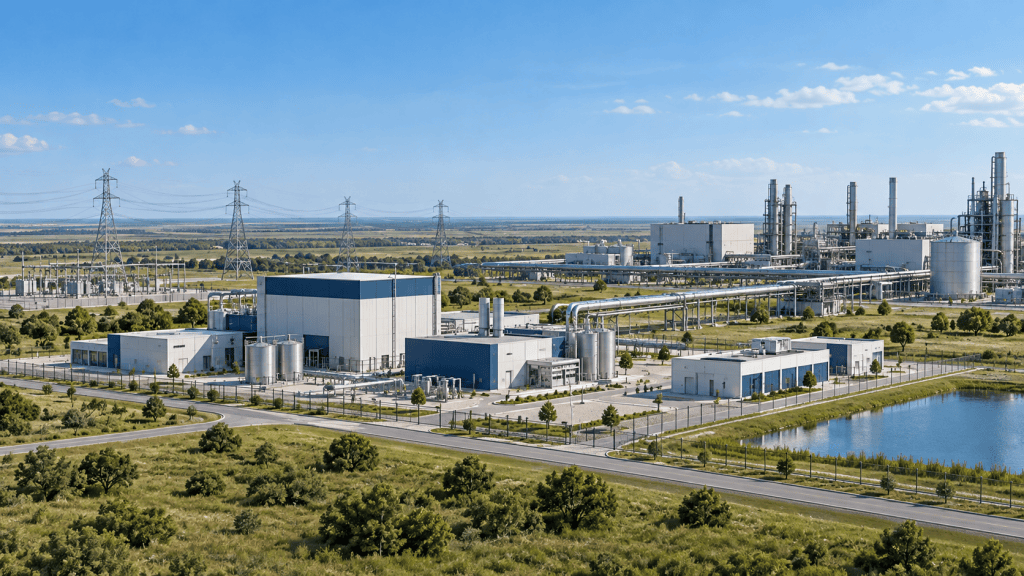
Conceptual illustration of an advanced nuclear installation supplying an industrial site. Original GNEI illustration created with AI; not a photograph or an engineering rendering of the proposed Long Mott plant.
REGULATION / DEPLOYMENT
On 30 October 2026, X-energy announced that the U.S. Nuclear Regulatory Commission had completed its Final Safety Evaluation Report for the Long Mott Generating Station, an Xe-100 high-temperature gas-cooled reactor plant proposed at a Dow industrial site in Texas. NRC staff concluded that the plant and site provide the safety basis to begin construction. The construction permit itself has not yet been issued: the NRC still lists the hearing and the permit decision as to be determined.
The Final Safety Evaluation Report (FSER) is the NRC staff’s documented conclusion on the safety case submitted under 10 CFR Part 50. According to X-energy, the review covered the plant’s principal design criteria, preliminary design, safety analyses, probabilistic risk assessment and research and development programmes. The Advisory Committee on Reactor Safeguards, the independent body that advises the Commission, separately reviewed the staff’s work and supports issuance of the construction permit.
The environmental side of the application was already complete. The NRC issued an Environmental Assessment and Finding of No Significant Impact on 18 May 2026. With both the safety and environmental reviews finished, the application now moves to the final stages: a hearing and a Commission decision on the permit. The NRC’s own project page lists both as “TBD”.
Where the project actually stands
Long Mott Energy tendered the application on 31 March 2025, and the NRC docketed it on 12 May 2025. The NRC’s published schedule had targeted the final safety evaluation for November 2026, so the review closed on or slightly ahead of plan. The project is part of the U.S. Department of Energy’s Advanced Reactor Demonstration Program, and Dow is the industrial partner. If built, it would be the first grid-scale advanced reactor at an industrial facility in the United States. That is a description of intent, not of an approved construction project.
Why the licensing route is notable
X-energy says the Xe-100 is the first construction permit application for a high-temperature gas-cooled reactor to use the NRC’s technology-inclusive, risk-informed and performance-based licensing framework. That approach builds on licensing modernisation work first developed for DOE’s Next Generation Nuclear Plant programme in 2008. Rather than applying requirements written for large light-water reactors line by line, the framework asks the applicant to identify licensing-basis events and show that safety functions are met for the specific design. X-energy began pre-application engagement with the NRC in 2018.
The design uses TRISO-X coated particle fuel in a pebble-bed core. X-energy states that its safety case supports a 400-metre emergency planning zone, compared with the 10 miles typical for conventional light-water plants. The company also argues that the review “establishes regulatory precedents for every Xe-100 project that follows”. Both are company statements. The NRC will review future applications individually, and how much of this review can be reused remains to be shown.
What remains open
The construction permit decision, its timing and any conditions are still pending. Construction cost, schedule and the later operating licence are separate questions that this milestone does not answer. Outside the United States, X-energy says the Xe-100 has been accepted into the UK’s Generic Design Assessment, which is an early step in a separate regulatory process.
Why it matters
The review is potentially more important as a regulatory precedent than as a single reactor milestone. If the NRC’s safety findings for Long Mott can be reused for later Xe-100 plants, the cost, time and uncertainty of licensing repeat units could fall, and repeat units are where nuclear construction costs have to come down.
GNEI significance
GNEI interpretation: this section is analysis, not factual reporting.
GNEI selected this story because it tests a central reform proposition: that technology-inclusive, risk-informed regulation can be applied to a new reactor type and then reused. Whether that reuse actually happens will tell us more about the future of advanced nuclear economics than the permit itself.
Primary source
X-energy, “NRC Completes Landmark Safety Review of X-energy’s Xe-100 SMR”, 30 Oct 2026
