
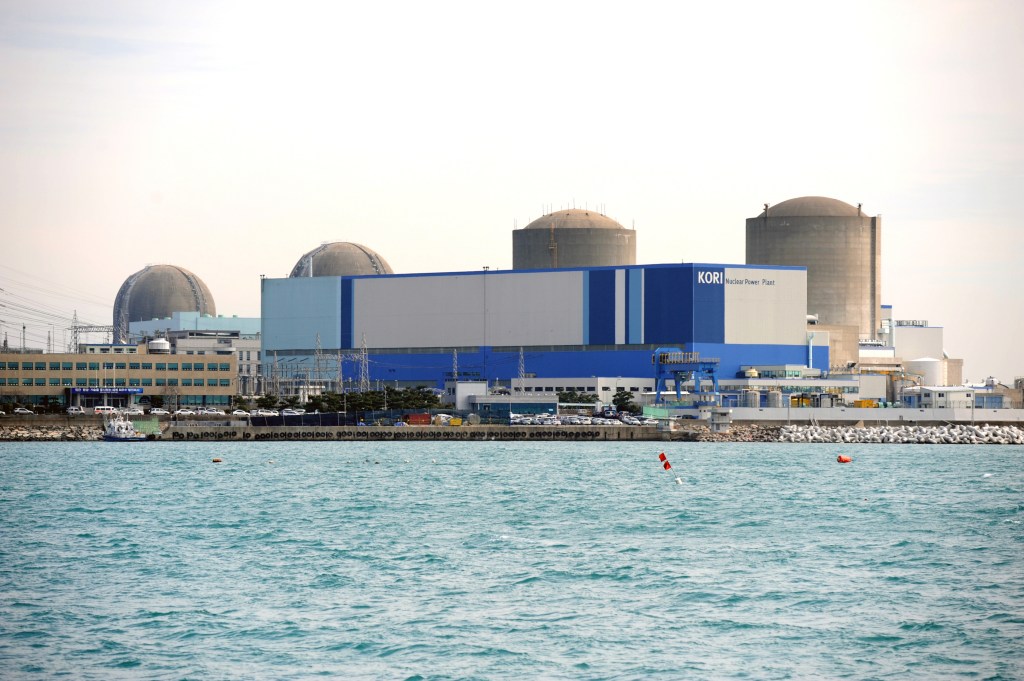
Kori Nuclear Power Plant, South Korea, photographed in 2008. Background image of conventional reactors; not an SMR facility. Photo: IAEA Imagebank / Korea Kori NPP / Wikimedia Commons, CC BY-SA 2.0. Resized for display; homepage cards use a layout crop. The photograph and its display crop remain available under CC BY-SA 2.0.
REGULATION
South Korea is building a dedicated regulatory framework for small modular reactors (SMRs), and its own documents show it arriving in stages. The SMR Special Act took effect on 11 September 2026. The Nuclear Safety and Security Commission (NSSC) has said it will draft SMR technical standards by the end of 2027 and overhaul the legal framework by 2030. According to Korea JoongAng Daily, a mature technology-inclusive, risk-informed, performance-based review methodology is targeted for 2032.
Korea’s current safety rules were written around large light-water reactors. The NSSC’s February 2026 roadmap acknowledged that this framework is difficult to apply to reactors built for different purposes and with different designs, such as marine propulsion, heat supply or hydrogen production. Several of those designs are already in development in Korea.
Three different milestones
The dates refer to different things and should not be merged into one timeline:
- 2027: draft SMR technical standards. The NSSC’s August 2026 work plan describes them as a technology-inclusive, performance-based “SMR Technical Standards Draft”, due by the end of 2027.
- 2030: legislative reform. The legal framework, now centred on large light-water reactors, is to be revised so that it covers reactors of diverse designs and purposes. The February roadmap plans detailed measures by 2027 and sequential revisions to laws and standards from 2028.
- 2032: review methodology. Korea JoongAng Daily reports that the NSSC’s tailored technology-inclusive, risk-informed and performance-based review methodology is targeted for 2032. The NSSC also plans technical standards and assessment methods covering the full life cycle of the i-SMR design by 2032.
Developers may arrive first
Industry timelines do not wait for this sequence. The government-led i-SMR applied for standard design approval in February 2026, and a construction permit application is planned for 2028. Korea JoongAng Daily reports that the regulator’s strategy anticipates three SMR pre-review applications in 2027 and five in 2028, including foreign designs. On that reading, developers may seek permits before the mature review methodology exists.
The regulator has recognised the problem. At an industry event on 28 October, the head of the NSSC’s SMR safety division said the commission had brought forward the development of review criteria to start in 2027, because delay “would become a period that hinders the commercialization of SMRs”. She noted that existing rules, including an emergency planning zone of about 30 kilometres, were built for large coastal plants. The NSSC is also introducing a pre-review process, so designs can be examined before a formal licence application. It runs research groups for each reactor type that bring together regulators, developers and researchers.
Political support versus institutional capacity
Political backing is not in doubt. The SMR Special Act sets up government-wide support for SMR research, demonstration and commercialisation. The government aims to commercialise a light-water SMR by 2035 and to begin construction of non-light-water SMRs in the 2030s. Rising electricity demand, including from AI and data centres, is part of the motivation. What remains uncertain is whether regulatory staffing, standards and methods will mature quickly enough. Korea JoongAng Daily cites the NSSC’s own estimate that its SMR staff needs to grow to 33 in 2027 and 39 by 2029–2030.
Why it matters
Korea is one of the world’s most capable nuclear builders and exporters. If even Korea’s regulator expects its full SMR review methodology to arrive after the first applications, regulatory readiness, not reactor technology or political will, could become the binding constraint on SMR deployment there and elsewhere.
GNEI significance
GNEI interpretation: this section is analysis, not factual reporting.
GNEI interpretation: even governments strongly committed to advanced nuclear can find that regulatory institutions develop more slowly than reactor technology. Korea’s effort to redesign regulation before deployment, through pre-review and technology-specific standards, is a model worth following. Its own timeline shows how hard that is to do.
Primary source
Additional sources
- NSSC, SMR Regulatory Framework Roadmap (draft), 12 Feb 2026 (Korean, PDF)
- DongA Science, NSSC second-half 2026 work plan
- DongA Science, SMR Special Act and Enforcement Decree take effect
- Korea JoongAng Daily, Korea’s SMR push: top-tier tech hits regulatory bottleneck
- MoneyToday, NSSC says regulation must keep pace with SMR commercialization, 28 Oct 2026

